
How Hospital Notaries Provide Stability in Crisis Moments
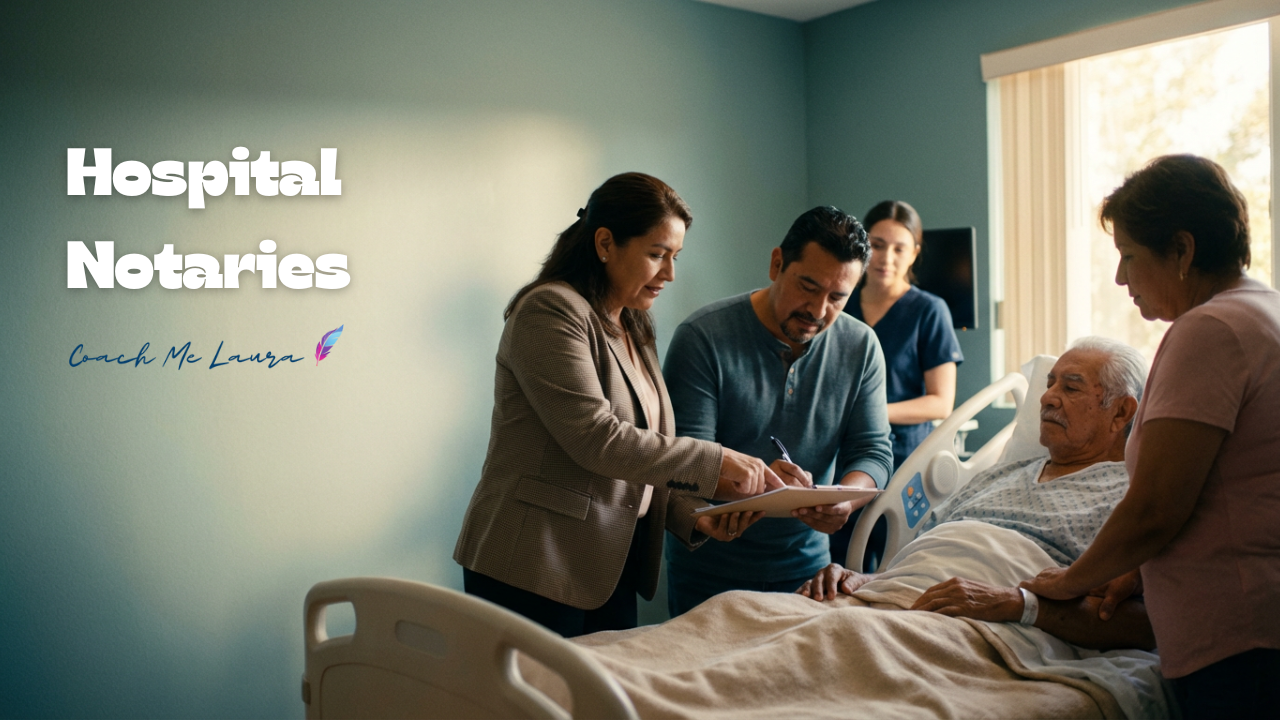
When the System Stalls, Preparation Steps In: What This Hospital Notary Review Teaches Us
There are moments when families don't just need a notary.
They need someone who knows how to move when everything else feels stuck.
Recently, a family contacted me for two separate hospital notarizations within just a few days—two different relatives, two medical emergencies, two urgent legal needs. Both hospitals were experiencing the same problem: delays getting documents to families who needed them immediately.
The family later wrote in a 5 star review that I had "gone above and beyond" by printing all the forms myself because they were "having a lot of issues and delays at the hospitals getting what we needed for some urgent matters."
But here's the thing: anticipating system breakdowns isn't going above and beyond.
It's understanding how medical environments function under strain.
Hospitals Are Focused on Care, Not Paperwork Logistics
Hospitals exist to treat patients. Documentation is secondary, and understandably so. But when legal documents intersect with medical urgency, that gap creates real problems for families.
Forms get delayed. Printers fail. Departments don't coordinate. A family is told documents are needed "right away," but no one can tell them how to get them completed. Meanwhile, visiting hours are limited, the patient's condition may be changing, and time is slipping away.
A hospital notary who waits for families to figure this out on their own isn’t neutral, they're adding to the chaos.
A hospital notary who arrives with documents printed, organized, and ready to execute is reducing the variables. Fewer things can go wrong. Fewer decisions fall on people who are already overwhelmed.
That's not customer service. That's operational understanding.
What "Incredibly Responsive" Actually Means
The family in this review noted that I "answered every question and call immediately." In medical situations, that kind of responsiveness isn't about being nice, it's about being a stabilizing force.
Families in crisis are fielding calls from doctors, navigating hospital policies, coordinating with siblings or spouses across time zones, and trying to make decisions they never expected to make. Every unclear answer, every delayed callback, every vague instruction becomes another source of stress.
Responsiveness in this context means knowing what questions to ask, what information really matters, what's urgent versus what can wait, and how to guide without overwhelming.
It also means recognizing when not to proceed. Sometimes the most responsive thing a notary can do is say, "Let's wait until tomorrow when your father is more alert," rather than rushing through because everyone feels pressure.
That judgment comes from experience and preparation, not personality.
The Test of Consistency
Perhaps the most revealing detail in this situation is that it happened twice in one week, same family, different relatives, same level of care.
Anyone can rise to the occasion once. A system allows you to do it repeatedly without cutting corners, burning out, or creating risk.
Consistency under pressure is what separates a prepared notary from someone who got lucky. It's also what generates trust. This family didn't just refer me to others because both appointments went smoothly, they referred me because they could see I had a process.
They didn't have to wonder if I'd be reliable the second time. They already knew.
Why This Work Requires More Than Availability
Hospital notarizations ask notaries to make real-time decisions that affect vulnerable people:
Is this the right moment to proceed, or should we wait?
Is the signer oriented enough to understand what they're signing?
Are all necessary parties present and comfortable?
Does the family understand what's happening and why?
What happens if hospital staff interrupts or asks us to leave?
These aren't hypothetical. They're the actual variables in play during a hospital appointment. A notary who hasn't thought through these scenarios in advance will hesitate, defer to the family (who may not know what's appropriate), or proceed when they shouldn't.
Families feel that uncertainty, even if they can't name it.
When the System Fails, Someone Has to Step In
I think about that family often, not because they left a glowing review, but because their situation was so common. Two emergencies. Two hospitals. Two sets of delays. And in both cases, the legal need couldn't wait for the system to catch up.
Someone had to bridge the gap between what hospitals are designed to do and what families urgently needed.
That role falls to the notary, but only if the notary is prepared to fill it.
This is why hospital notarization isn't a side service you add to your offerings. It's a specialty that requires judgment, systems, and the ability to make decisions under pressure. It requires showing up not just with a stamp, but with a framework.
Because when systems stall and families are stretched thin, professionalism isn't loud or flashy.
It's steady. It's prepared. And it moves things forward when nothing else can.
At your service,
Laura
Laura Biewer is a 22 yr notary veteran specializing in hospital and medical environments and author of the Amazon bestselling book The Compassionate Notary: A Field Guide to Hospital, Hospice and Homebound signings

Certified Notary Trust Delivery Agent
Earn Up To $250 Per Appointment Notarizing Estate Planning Documents
Did you know that every living trust package, in every state, requires 6-8 notarizations (or more)? An attorney is not required, but a notary is! Typical fees for "trust delivery" average $125-$250 per appointment.
If you're tired of low-ball signing appointment offers, being treated like a "dime-a-dozen" by escrow officers, driving all over town for minimal pay, printing hundreds of pages at your expense, or waiting for the federal government to lower interest rates?
Then becoming a Certified Notary Trust Delivery Agent (CNTDA) might be the next step in your notary career.
FREE DOWNLOAD
Hospital Notarization Guide
Are you trying to get into a hospital to provide notary service? Just add your name and email here and I'll send you my guide: "Steps to successful hospital notarizations" as well as a PowerPoint training you can use for medical staff.

Laura Biewer
Mentor / Coach
Based in Modesto CA, Laura has over 20 yrs experience as a mobile notary and Certified Loan signing agent. She has developed expertise in notary laws and regulations as a CA mandated training instructor. In addition, Laura is able to assist notaries in all 50 states with notary, marketing, networking and branding questions.
